
By PAN Contributor Cody Wolfe
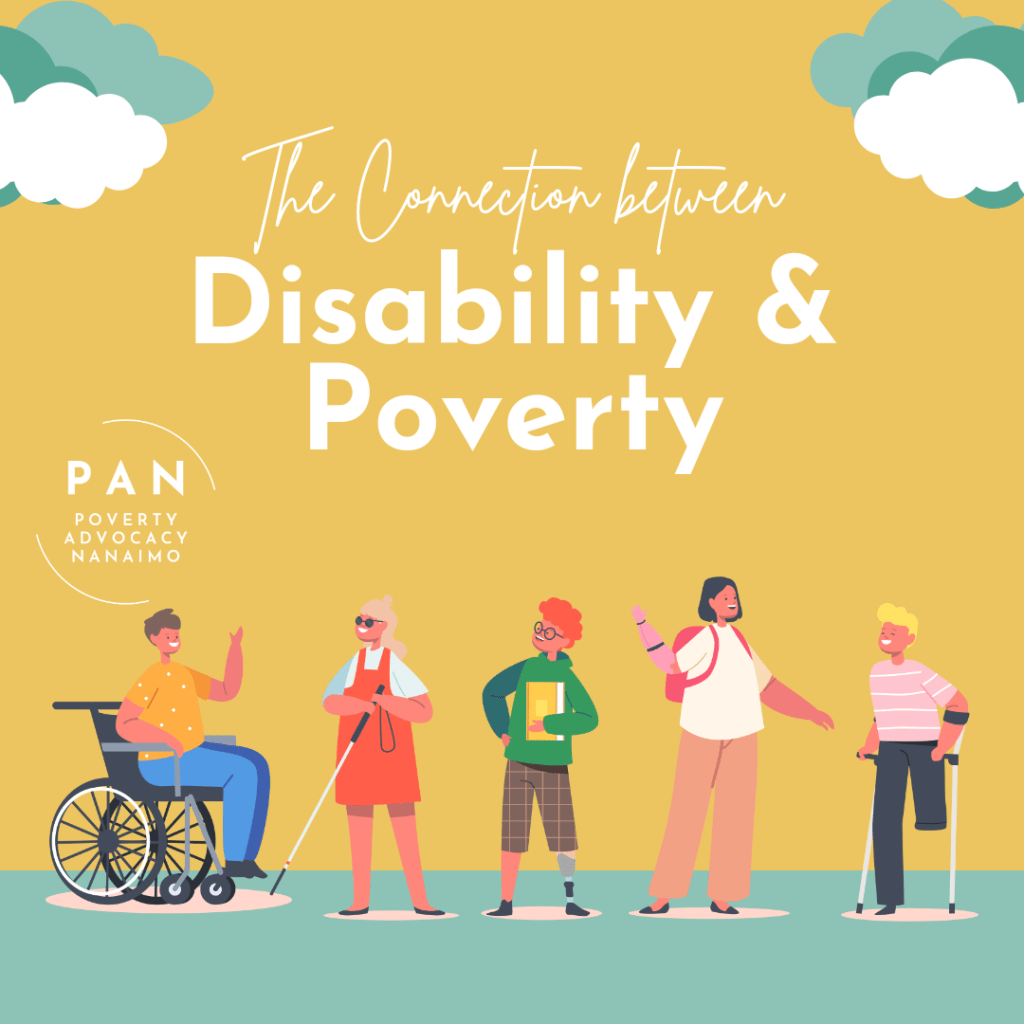
Persons with disabilities are less likely to experience financial security and more likely to live in poverty than persons without disabilities. In 2020, 20% of persons with disabilities aged 15 and over lived in poverty compared to 7% of their counterparts without disabilities(1). There is growing research in support of an association between disability and poverty and of a cycle by which poverty and disability are mutually reinforcing. Physical, cognitive, mental, emotional, sensory, or developmental impairments independently or in tandem with one another may increase one’s likelihood of becoming impoverished, while living in poverty may increase one’s potential of having or acquiring a disability in some capacity.(2)
How does this cycle work?
There are many ways that disability and poverty interact. People with disabilities may have higher costs of living, due to things such as needing medications, or healthcare equipment, taking time off work for doctor appointments, and difficulty finding appropriate child care for those with disabled children. Another contributing factor is that disabled people are more likely to be unemployed(3), thereby increasing their likelihood of becoming impoverished. Depending on one’s type of disability, their impairments may complicate their ability to manage their problems on their own. A lack of a support system in the form of family or friends may further damage one’s ability to take care of themself and stay on top of their living expenses.
Once one is impoverished, it is difficult to get out. All the more so if they are recovering from a recent knee surgery, or have a developmental disability, or have mental health problems. Poverty increases one’s chances of acquiring otherwise preventable impairments; for example, the man with a recent knee surgery can’t help but notice his bills piling up, and his savings shrinking, and returns to work sooner than he really ought to, potentially jeopardizing his recovery. Those with chronic anxiety are at a higher risk of developing a myriad of diseases, and in a dire financial situation they’re less likely to be able to afford treatment. Thus we see how disability and poverty become intertwined.
Sources:
https://publications.gc.ca/collections/collection_2024/statcan/89-654-x/89-654-x2024001-eng.pdf
Wikipedia https://en.wikipedia.org/wiki/Disability_and_poverty
Accessibility and Persons with Disabilities – Statcan https://www150.statcan.gc.ca/n1/pub/12-581-x/2023001/sec5-eng.htm
 Poverty Advocacy Nanaimo